
Heat waves, higher prices?
Evidence from European futures markets suggests this won't be another 2022 (so far)

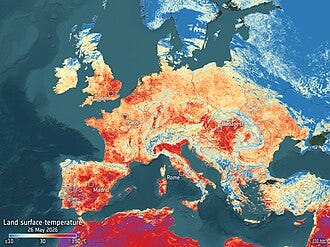

A Swedish journalist asked me today about how the heat waves in Europe will affect food prices. There have been several periods of high temperatures in May, June and July 2026, most notably in France. I thought I’d write a short post with my thoughts on the economic impacts of these recent extreme weather events.
There are many reports from government sources that these heat waves have had a negative impact on agricultural production. The Agricultural Market Information System (AMIS) writes that the lower wheat production in France is one of many factors contributing to higher wheat prices globally. Other factors affecting grain prices right now include growing conditions in the U.S. and Russia, as well as the ability of Ukraine and Russia to export from the Black Sea.
There are lots of other commodities affected by the heat waves, including fruits and vegetables. Reports suggest that heat waves reduced production of those items as well. Sweden imports lots of fruit and vegetables from Southern and Western Europe, so poor production could lead to a combination of higher prices here in Sweden and shifting to sourcing from other regions.
The case of wheat
Although many food commodities are affected, I'm focusing on wheat here since it's both a dietary staple and one of the crops most directly affected by the heat waves in France. It also helps that we have good price data. Wheat futures markets give us an unusually clear window into how traders are pricing in these risks.
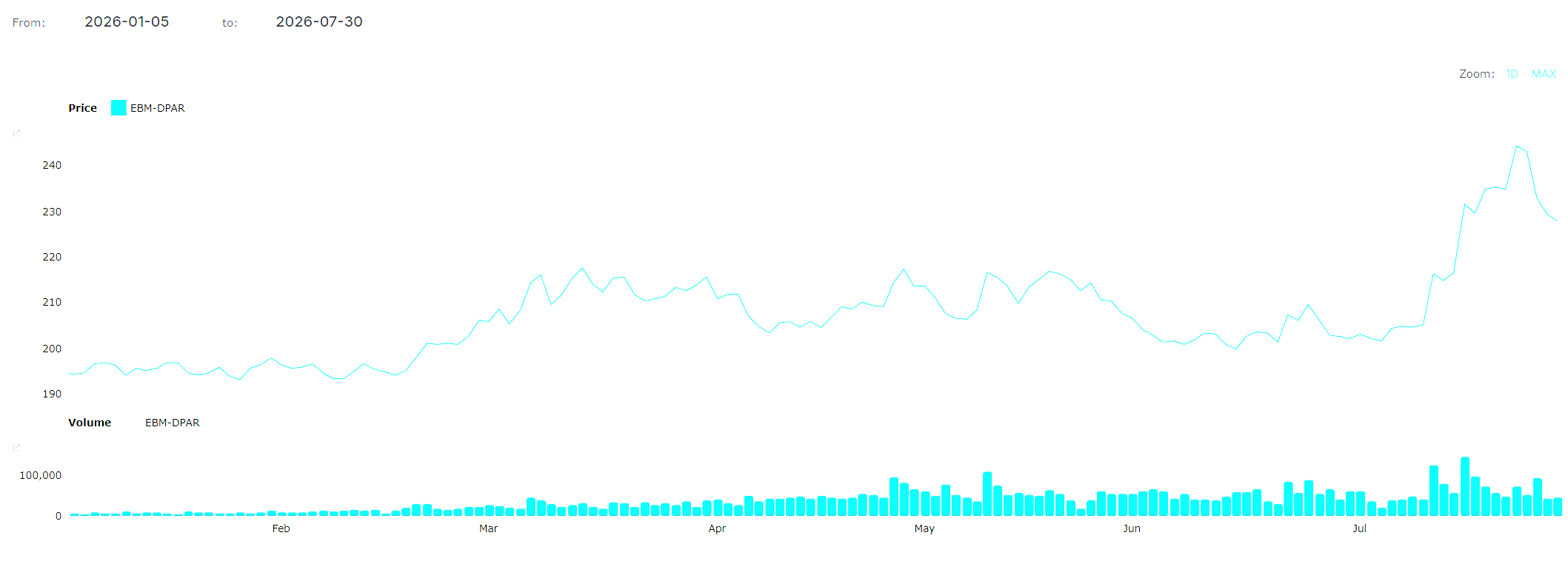
The graph below shows the futures price for wheat in Paris. Futures prices are very useful signals because they reflect what the market thinks the price will be in the near future (September 2026 in this case). In futures markets, people are putting their money where their mouth is, so these price predictions reflect real financial stakes, not just talk. The price of the Paris September 2026 wheat contract has increased a lot recently, to a high of nearly EUR 250/tonne.
How does this compare to 2022?
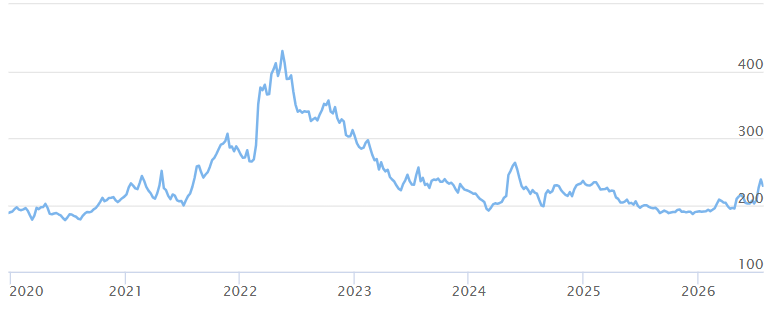
It can be useful to compare what’s happening now with the price shock in early 2022, after Russia’s full-scale invasion of Ukraine. Here it’s useful to look at a longer time series of nearby futures prices that are spliced together. Here we see that Paris wheat prices have increased recently, but nowhere near the magnitude experienced in 2022. The pattern is similar for other commodities like corn.
What else could move prices?
There is a lot of uncertainty now about food production, owing in part to the strong El Niño and also the closure of the Strait of Hormuz. All of these factors can contribute to higher food prices as well. So, my prediction is that food prices are set to increase this fall, but not as much as we experienced back in 2022.