
How would capping payments affect EU farmers?
Could fewer subsidies for large farms make small farms great again?

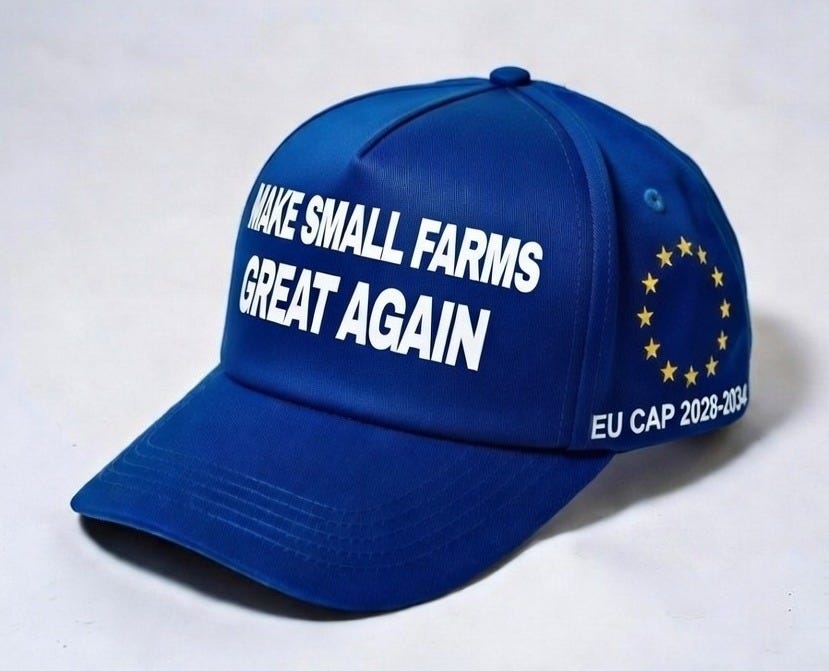
One of the biggest proposed changes to the EU Common Agricultural Policy (CAP) in the coming 2028-2034 period is Degressive Area-Based Income Support (DABIS), which would cap income support payments at EUR 100,000 per farm. Larger farms would therefore receive less support per hectare. What does this mean for smaller farms, whose payments remain unchanged?
The motivation for this proposed reform is mostly politics. A relatively small number of farms receive most of the subsidies, which many see as unfair. The optics were even worse in countries where production is dominated by a handful of very large agribusiness firms rather than large family farms.
I wrote a post a while back about how DABIS and capping could create perverse incentives for farms to split into smaller holdings to circumvent the rules, artificially inflating the number of small farms in official statistics. This workaround is unlikely to cancel out the full impact of DABIS and capping, however, so real effects are still probable. I outline them below.
The impacts of DABIS and capping
The primary effect will be distributional, as larger farms receive relatively less and smaller farms relatively more of the total funds. But there could be knock-on effects via land markets. Large farms typically outbid smaller ones for land, but with reduced subsidies they will not be able to pay as much. This could soften farmland prices and rental rates in regions where large payments are most common, giving smaller farms a better shot at expansion.
Small farms could also benefit if the savings from capping are redirected toward types of support they receive in greater proportion. Since the CAP proposal gives member states more discretion over how funds are used, impacts will vary by country.
Government and farmer perspectives
I attended a seminar on the future of the CAP last week at the Royal Swedish Academy of Agriculture and Forestry in Stockholm. The Swedish State Secretary for Agriculture argued for a higher payment ceiling under a future DABIS, noting that the ministry’s analysis suggests the current proposal would affect 6,000 farms in Sweden (around 10%), accounting for 60% of crop production.
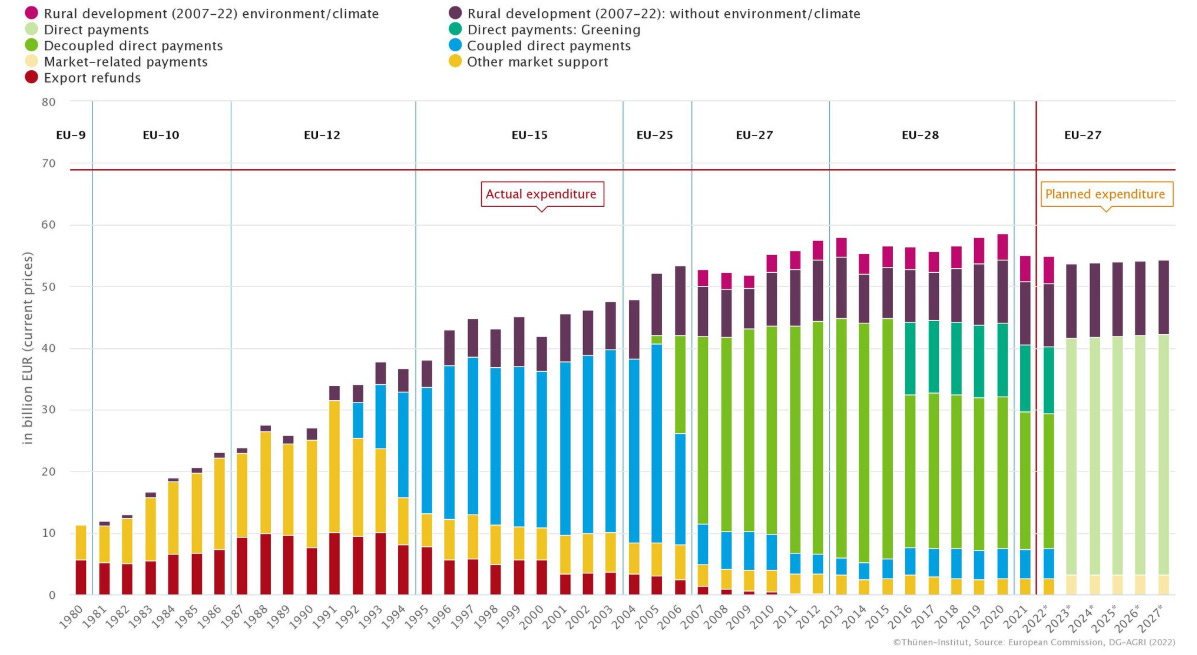
The farmers present had mixed views. One argued the EU CAP alone cannot solve agriculture’s underlying profitability problems. Another, with a large operation, said the CAP has become increasingly irrelevant to his business, which is unsurprising given that payments have not kept pace with inflation. The graph below show that total EU CAP expenditures haven’t increased in nominal terms since 2010.
Both the government representative and farmers at the seminar agreed that more support for production increases is needed. The current Swedish government’s “National Food Strategy” aims to increase Sweden’s food production. This would mark a reversal of the EU-wide trend over the past two decades, during which support was progressively decoupled from production, hence the shift to per-hectare rather than per-tonne payments. The ceiling on coupled payments in the current 2021-2027 CAP is 13% (plus an extra 2% earmarked for protein crops), and in the new proposal would raise this to at least 20%.
The final shape of DABIS will depend on negotiations still to come, and national implementation choices will determine who actually wins and loses. It is worth watching both levels closely. Stay tuned for further developments on the EU CAP post-2027.